Visiting Santa Bárbara Castle, Alicante: lift, walking route and what to see
Updated
Santa Bárbara Castle in one minute
- Entry: Santa Bárbara Castle is free to visit. The lift costs EUR 2.70, with free travel for over-65s; some special visits and events cost extra. Figures checked 7 November 2026.
- Hours: every day from 10:00; closing 18:00 in winter, 20:00 in spring and autumn, 23:00 in summer. Closed 24 June, 24, 25 and 31 December and 1 and 6 January. See hours by season.
- Getting up: the lift opposite Postiguet beach, a microbus from the centre, two signposted walks of about 30 minutes, a taxi, or a car drop-off. See five ways up.
- How long: at least an hour; allow two to three with the museum rooms. Late afternoon is the pleasant time, and in summer the castle stays open until 23:00.
- Why: the best view in Alicante: 166 metres above the sea, 360 degrees over the port, the beaches and the hills.
Map of Alicante castle (Santa Bárbara)
The map shows the castle on the Benacantil rock, the lift entrance opposite Postiguet, the microbus stops, the Parque de la Ereta and the Cara del Moro.
Tap a number or a name for details.
- TRAM line (dashed: underground)
produced using Copernicus WorldDEM-30 © DLR e.V. 2010-2014 and © Airbus Defence and Space GmbH 2014-2018 provided under COPERNICUS by the European Union and ESA; all rights reserved© OpenStreetMap contributors (opens in a new tab)
1 Microbus stop Puerta del Mar
The shuttle to the castle starts here, where the airport bus also stops.
3 Microbus stop by the MARQ
On Plaza del Doctor Gómez Ulla, opposite the MARQ museum, before the shuttle climbs to the castle gate.
5 Parque de la Ereta
Terraced park between Santa Cruz and the castle, the city's best free viewpoint.
7 MUSA, city history museum
The city's history museum, with rooms across the castle's enclosures and free entry.
Castle of Santa Bárbara, Alicante, Spain: at a glance
| What it is | A medieval fortress on Mount Benacantil, 166 m above the city; one of the largest in Spain; a listed monument (Bien de Interés Cultural) since 1961 |
|---|---|
| Admission | Free. Temporary exhibitions and some guided tours may be ticketed |
| Hours | Every day from 10:00; closing 18:00 in winter, 20:00 in spring and autumn, 23:00 in summer; no entry in the last 30 minutes. Hours by season |
| Closed | 24 June, 24, 25 and 31 December and 1 and 6 January; closes at 21:00 from 25 to 29 June; earlier closing on event days |
| Lift | Avenida Juan Bautista Lafora, opposite Postiguet beach; EUR 2.70; free for retirement pensioners and people over 65; last ascent 40 minutes and last descent 20 minutes before the lift closes |
| Microbus | Puerta del Mar – Postiguet walkway – Plaza Dr. Gómez Ulla (MARQ) – castle, every 40 minutes; EUR 1.50 (city council and tourism office; the castle website still shows EUR 1.45) |
| On foot | Two signposted routes of about 30 minutes, moderate: from the town hall through the old town and the Ereta park, or from Postiguet up the west side |
| Parking | None inside; cars may drop passengers at the gate; Ereta and MARQ car parks below |
| Dogs | Allowed on a lead through the old guardhouse entrance; not in the lift, the halls or the museum; muzzle where the law requires it |
| Accessibility | The lift reaches the upper levels; the castle publishes no step-free routes or adapted-toilet locations, so ask at the gate |
| Guided visits | Free, daily, in Spanish and English, the same timetable all year; theatrical visit Saturday and Sunday at 12:00; book in person at the visitor centre, half an hour to an hour before. Timetable of the guided visits |
Santa Bárbara Castle opening hours by season
The castle opens at 10:00 every day of the year except six, and the closing time follows the season. The castle website (checked 7 November 2026) gives these blocks:
Winter 15 November to 27 February
- Every day
- 10:00–18:00
Spring 28 February to 16 June
- Every day
- 10:00–20:00
Summer 17 June to 4 September
- Every day
- 10:00–23:00
- The walls and the views are open after dark
Autumn 5 September to 14 November
- Every day
- 10:00–20:00
These are the usual dates; the source publishes no year.
Closed: 24 June (the night of the Hogueras bonfires), 24, 25 and 31 December and 1 and 6 January. From 25 to 29 June the castle closes at 21:00.
What those seasons feel like on the hill: December and January for the short winter days, June, July and August for the late openings and the heat.
- Last entry: no access to the fortress in the last 30 minutes; the lift stops taking people up 40 minutes before it closes and down 20 minutes before.
- Event days: concerts and performances inside the castle bring earlier closures; the castle's programme page announces them. Bad weather can close it too: check on the day.
Getting up: five ways
The castle sits 166 metres above Postiguet beach, and every way up starts within a few hundred metres of the city centre. The castle operator itself recommends the taxi for anyone in a hurry; most visitors take the lift up and walk down.
- Castle entry
- Free
- Temporary exhibitions and some guided tours may be ticketed
- Lift
- EUR 2.70
- Free for retirement pensioners and people over 65, with proof
- Microbus
- EUR 1.50
- City council and tourism office; the castle website still shows EUR 1.45
- Ereta car park
- Free
- As the castle's FAQ says; no parking inside the fortress
The Alicante castle lift from Postiguet beach
The Santa Bárbara Castle lift entrance is on Avenida Juan Bautista Lafora, across the road from the middle of Postiguet beach: a tunnel leads into the rock, and two lifts rise inside the mountain to the top. A ticket costs EUR 2.70, separate from any ticketed events or special visits; retirement pensioners and people over 65 ride free with proof.
Santa Bárbara Castle tickets for the lift are sold at the entrance, and the city council links an official online portal for lift tickets (castillosantabarbara.alicante.es, “Realizar una reserva”: access by lift, type of visit, day). We opened the portal on 13 November 2026 and did not complete a purchase, so we cannot say how payment works.
Count on the queue at the tunnel in July and August, when the wait can take longer than the ride. The lift keeps the castle's hours, with the last ascent 40 minutes and the last descent 20 minutes before closing. Dogs may not use it.
The microbus
A small shuttle bus runs from Puerta del Mar (where the airport bus C6 stops) via the Postiguet walkway and Plaza del Doctor Gómez Ulla, opposite the MARQ museum, up to the castle gate and back, roughly every 40 minutes during opening hours. The fare is EUR 1.50 according to the city council and the tourism office; the castle website still shows EUR 1.45.
Pay on board by bank card or bus pass; no cash is accepted (city council page, 6 November 2026). It is the easiest option with a pushchair or tired legs, and the only public transport that reaches the gate.
The Alicante castle walk: two signposted routes
Both official routes take about 30 minutes at a moderate pace, with steps and slopes, and both are better in the morning or the evening in summer.
- Route 1, from the town hall through the old town: up through the Barrio de Santa Cruz, past the whitewashed houses and the flower pots, into the Parque de la Ereta, whose terraces are the city's best free viewpoint, and on to the gate.
- Route 2, from Postiguet beach: along Calle Virgen del Socorro with the beach below, then the path up the west face of Benacantil, with the northern side of the city and the hills opening up as you climb.
- Coming down: the route through Ereta park and Santa Cruz brings you into the old town, with places to stop for a drink. If you would rather avoid the descent, take the lift and check its last departure time.
Taxi
A taxi drives to the gate and is the operator's recommended option. The castle publishes approximate fares (checked 7 November 2026):
Approximate fares
- From the Perpetuo Socorro stop
- EUR 4–5 by day
- EUR 5.20–6 at night or on holidays
- From the Mercado stop
- EUR 4.50–5.50 by day
- EUR 5.50–6.50 at night or on holidays
- From Plaza del Mar
- EUR 6–7 by day
- EUR 7–8 at night or on holidays
- From the Hotel Meliá
- EUR 6.50–7.50 by day
- EUR 7.50–8.50 at night or on holidays
- From the cruise terminal
- EUR 8–9
Ask the driver to wait if you only want ten minutes at the top.
By car
You can drive up Calle Vázquez de Mella to drop people at the entrance, which helps with reduced mobility or small children, but you cannot park inside the fortress. The castle points to the Ereta car park on the mountain itself (free, as the castle's FAQ says) and the MARQ car park below.
What to see inside
The fortress is three enclosures stacked up the mountain, each from a different century, with the oldest at the top. Allow an hour for a loop, more if the exhibitions are open; the viewpoints are at every level.
The upper enclosure: La Torreta
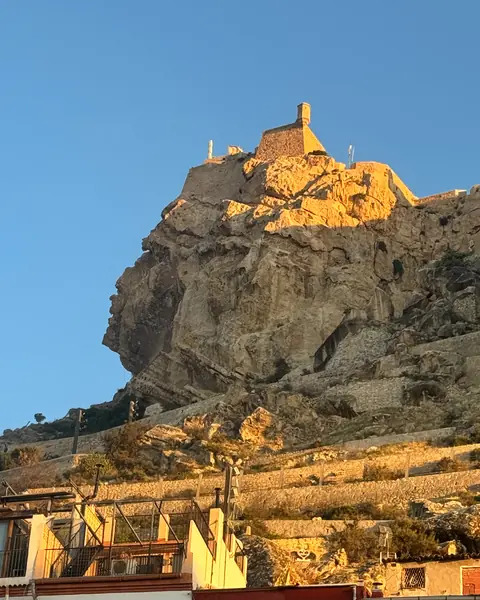
The highest part is the oldest, with the keep known as La Torreta, the Macho del Castillo esplanade and remains of the medieval fortress. This is the 360-degree viewpoint: Postiguet and the port below, the Explanada and the old town, the Serra Grossa and the long beach of San Juan to the north, the hills inland.
The middle enclosure: the Felipe II works
The middle level was built between 1562 and 1580 under Philip II and holds the large halls and courtyards: the Felipe II hall, the Patio de Armas with the information desk and the shop, the Cuerpo de Guardia, the Baluarte de la Reina and the former hospital and cistern, some of which open only on guided visits (the old dungeons, the Renaissance cistern under the Patio de Armas and the old hospital are seen only on the guided visit).
The lower enclosure
The lowest level dates from the 18th century, with the Revellín del Bon Repós at the entrance, where cars drop visitors and where the microbus arrives.
MUSA and the exhibitions
The castle houses the MUSA, the city's history museum, with rooms across the enclosures and free entry, plus temporary exhibitions and children's activities; the city council publishes a children's guide to the castle in Spanish, English and French.
Kiosks at the Baluarte de la Reina and by the Cuerpo de Ingenieros and a café above the Ermita de Santa Bárbara sell drinks and snacks; you may eat and drink only in the areas set aside for it.
The Cara del Moro
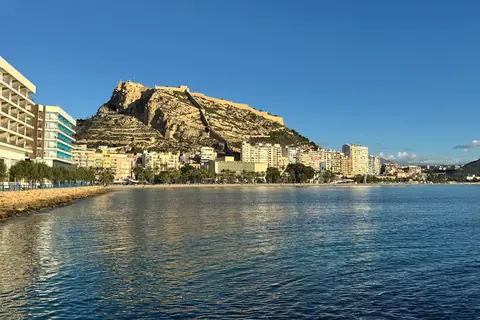
Seen from Postiguet beach, the rock face of Benacantil forms a profile, the "Moor's face", and the city's favourite legend hangs on it: the daughter of the Moorish lord, two suitors, a canal from Tibi and a voyage to the Indies, two deaths and a father turned to stone. The castle tells the story on its website and on panels; the legend even claims the city's name comes from the princess, Cántara.

Guided visits, theatrical visits and events
The castle runs free guided visits every day, in Spanish and in English, and theatrical weekend visits and night performances whose prices it does not publish. Places for the free tours are booked in person at the visitor centre in the Patio de Armas, next to the shop; the castle asks for half an hour on one page and an hour on another, so come early.
There is no online booking for the free tours; the theatrical visits can also be booked on the castle's website. The timetable the castle publishes is the same all year (checked 9 November 2026):
Monday to Friday
- 11:00
- English
- 13:00
- Spanish
- 15:30
- English
- 17:30
- Spanish
Saturday and Sunday
- 11:00
- English
- 12:00
- Theatrical visit in Spanish
- 15:30
- English
- 17:30
- Spanish
- Length and size: about an hour, groups of about 15; Valencian on request.
- Theatrical visits: Saturdays and Sundays at 12:00, plus night-time "mysteries of the castle" performances in the programme.
- Events: concerts, wine, chocolate and craft-beer tastings and school activities appear in the castle's programme; on event days the fortress may close early.
- Groups: the tourism office asks organised groups to book with a form at least 48 hours ahead.
History in dates
From the city council's history of the castle and the castle's own pages (checked 7 November 2026):
- 9th century: a Muslim fortress on Benacantil guards the port of Al-Laqant; traces of earlier Iberian and Roman use are found on the hill.
- 4 December 1248: Castilian troops led by the future Alfonso X take the castle on Saint Barbara's day, which gives it its name.
- 1296: James II of Aragon storms the castle; Alicante passes to the Crown of Aragon.
- 1562–1580: Philip II has the fortress rebuilt as a modern artillery stronghold; most of the middle enclosure dates from these works.
- 1691: a French fleet bombards the city for seven days.
- 1706–1709: in the War of the Spanish Succession the castle is held by British troops and taken back after a mine is exploded under it.
- 1873: the frigate Numancia shells the city during the cantonal revolt.
- 18th to 20th century: the fortress serves as a prison; in 1939 it is used as a camp for Republican prisoners after the Civil War.
- 1963: the lifts are opened and the castle becomes a public monument; declared Bien de Interés Cultural in 1961.
Practical tips
- Time: an hour for the loop and the views; two to three hours with the museum rooms, an exhibition and a drink at the top.
- When: late afternoon for the light, sunset for the photographs; in summer go after 19:00, when the castle stays open until 23:00 and the heat has gone. Mornings are quietest.
- Heat and shade: the esplanades have no shade; carry water, a hat and sunscreen from May to October. The kiosks sell drinks.
- Toilets and food: toilets, kiosks and a café inside; picnics only in the designated areas.
- Dogs: welcome on a lead through the old guardhouse entrance, not in the lift, the halls or the museum; dogs the law classes as dangerous must be muzzled; guide dogs go everywhere.
- Reduced mobility and pushchairs: the lift and the microbus avoid the climb; the castle publishes no step-free routes or adapted-toilet locations, so ask at the gate. Cars may drop passengers at the gate.
- With children: the city's children's guide (PDF, in English), the scale of the walls and the cannons, the lift ride inside the mountain, and the ice-cream reward at Postiguet afterwards.
- Photography: the upper esplanade for the port and the beach, the north wall for San Juan, the lift exit for the city roofs.
Views from Alicante castle
From the top the whole of Alicante is laid out: Postiguet beach and the Explanada directly below, the port with the marina and the cruise terminal, the old town's roofs and the bell towers of Santa María and San Nicolás, the Serra Grossa ridge and, beyond it, the sweep of Playa de San Juan to the Cabo de las Huertas; inland the Benacantil's neighbour, the Tossal, with the Castillo de San Fernando, and the hills towards Elche.
On clear days Tabarca island shows on the horizon. The best known view of the castle itself is from the beach: look up from Postiguet and the rock shows the Moor's face.
Nearby and combinations
Everything around the castle is on the way up or down: Postiguet beach at the foot of the lift, the Barrio de Santa Cruz and the Ereta park on route 1, the MARQ archaeological museum at the microbus stop, the Explanada and the port ten minutes from the beach. A half-day plan that works: lift up at 17:00, the loop and the views, walk down through Santa Cruz to the old town at dusk, dinner in the Barrio. For the rest of the city see things to do in Alicante; for the beaches, the beaches guide.
Frequently asked questions
Is Santa Bárbara Castle in Alicante free?
Yes. Entry to the fortress is free; the lift costs EUR 2.70 (free for over-65s and retirement pensioners), and some theatrical visits and exhibitions are ticketed.
How long does it take to walk up?
About 30 minutes on either signposted route, with steps and slopes; longer in the midday heat. Most visitors take the lift up and walk down through the Ereta park.
Is there a lift, and where is it?
Yes: the entrance is on Avenida Juan Bautista Lafora, opposite Postiguet beach. Two lifts rise inside the rock to the top. EUR 2.70, free for over-65s; last ascent 40 minutes before closing.
Is it worth visiting?
For the view alone, yes, and it costs nothing. Add the museum rooms, a guided visit and a summer evening on the walls and it is the best two hours in the city.
Can I park at the castle?
No. Cars may drop passengers at the gate; park at the Ereta car park on the mountain or at the MARQ below, or take the lift, the microbus or a taxi.
Which Castillo de Santa Bárbara is this?
Santa Bárbara Castle, Alicante, Spain, on Mount Benacantil. Several Spanish towns have a castle of the same name, and Santa Barbara is also a city in California; this page is about Alicante's fortress. The smaller Castillo de San Fernando stands on the next hill.
Was Game of Thrones filmed here?
No. The series' Spanish castle locations were elsewhere (for example Peñíscola and Girona); Alicante's castle appears in other productions.
Can I bring my dog?
Yes, on a lead, through the old guardhouse entrance and not in the lift, the halls or the museum; muzzle where required. Guide dogs are exempt.
Sources
- Castillo de Santa Bárbara, official website: castle information (opens in a new tab) (hours by season, closed days, lift, taxi fares, walking itineraries, microbus, car access, rules), FAQ (opens in a new tab) (free admission, guided and theatrical visits, parking, dogs, contact), programme (opens in a new tab); checked 7 November 2026.
- Alicante tourism office (Alicante City & Beach): Castillo de Santa Bárbara page (opens in a new tab) (hours, lift, microbus EUR 1.50, stops, group bookings, MUSA); checked 7 November 2026.
- Alicante city council: Castillo de Santa Bárbara heritage page (opens in a new tab) (history with dates, the three enclosures, the 1963 lifts, children's guides); last updated by the council on 30 November 2022, read 7 November 2026.
- Alicante city council: Castillo de Santa Bárbara facility page (opens in a new tab) (online lift tickets, closed days, closing time from 25 to 29 June) and the castle's booking portal (opens in a new tab); read 13 November 2026.