Alicante Old Town guide: streets, sights and where to eat
Updated
Alicante's old town in one minute
- What it is: Alicante's old town is the compact quarter between the Rambla de Méndez Núñez, the Explanada and the castle hill, with the town hall, the two big churches and the tapas streets. Locals call it the Casco Antiguo or simply El Barrio; the whitewashed stairs above it are the Barrio de Santa Cruz, steeper, and worth the climb for the viewpoints.
- Cost: walking it is free. The two churches charge for the cultural visit: Basílica de Santa María EUR 6, Concatedral de San Nicolás EUR 8 (audio guide included). The town hall's archaeological space is free on weekday mornings.
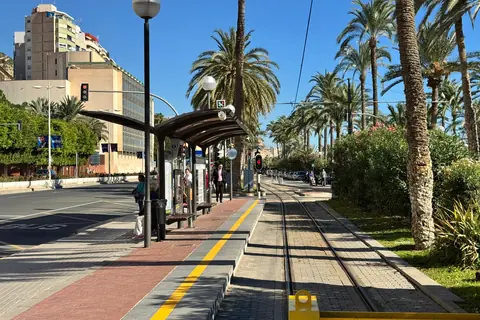
- Getting there: TRAM to Mercado or Luceros (lines 1 to 4), the airport bus C6 to Mercado-El Sabio, or on foot from the Explanada. It is a pedestrian zone. See getting there.
- How long: an hour for the walk; half a day with both churches, the town hall and lunch.
- When: mornings for the churches and the market, Saturday afternoon for the tardeo, after 23:00 for El Barrio's bars, which now close at 00:30 (01:00 on Fridays and Saturdays). See El Barrio by night.
Map of Alicante's old town
This Alicante old town map shows the triangle between the Rambla, the Explanada and the castle hill, with its two churches, the town hall, the MACA, the Mercado Central and the TRAM stops.
Tap a number or a name for details.
- TRAM line (dashed: underground)
produced using Copernicus WorldDEM-30 © DLR e.V. 2010-2014 and © Airbus Defence and Space GmbH 2014-2018 provided under COPERNICUS by the European Union and ESA; all rights reserved© OpenStreetMap contributors (opens in a new tab)
2 Mercado Central
The market hall up Calle Alfonso X el Sabio, with market bars for a mid-morning snack.
Alicante old town, Spain: at a glance
| Where | Between the Rambla de Méndez Núñez (west), the Explanada and the port (south) and the slope of Mount Benacantil (north and east); postcodes 03001–03002 |
|---|---|
| Names | Casco Antiguo (the old town), El Barrio (the same streets, said by locals, especially for the bars), Barrio de Santa Cruz (the whitewashed upper part only); the "Centro tradicional" is the grid west of the Rambla |
| TRAM | Mercado and Luceros (L1, L2, L3, L4), MARQ-Castillo (L1–L4), Puerta del Mar (L5); all within ten minutes on foot |
| Bus | City lines along the Rambla (2, 3, 5, 8, 10, 12, 13, 21, 22) and at Puerta del Mar (2, 21, 22); the airport bus C6 at Mercado-El Sabio and Puerta del Mar |
| Basílica de Santa María | Cultural visit Mon–Sat 10:00–19:00, Sun 13:00–19:00; EUR 6, free for children 12 and under with an adult; closed to visitors during mass. Hours and prices |
| Concatedral de San Nicolás | Cultural visit Mon–Sat from 10:30, Sun from 13:30; EUR 8, free for children 12 and under with an adult; the church itself is open free for worship morning and evening. Hours and prices |
| Town hall | The cota cero marker and a Dalí sculpture at the foot of the main staircase; La Ciudad Descubierta archaeological space under the annex, free, Mon–Fri from 9:00; the Salón Azul and the other rooms can be seen individually in the same hours (town hall, 11 November 2026). Opening hours |
| Museums | MACA, MUBAG and the Museo de Aguas are free; see the museums guide |
| Nightlife | El Barrio around Plaza San Cristóbal and Calle Labradores; since November 2025 bars close at 00:30 (01:00 Fri, Sat and holiday eves). All closing times |
| Time needed | One hour for the walk, half a day with the churches, the town hall and lunch |
Where the old town is, and what the names mean
Alicante's old town is a triangle. Its west side is the Rambla de Méndez Núñez, the avenue laid out in 1858 on the line of the medieval wall; its south side is the Explanada and the port; its third side is the foot of Mount Benacantil, where the streets turn into stairs.
Inside the triangle, on the flat, stand the town hall with its two towers, the Concatedral de San Nicolás, the Basílica de Santa María, the MACA and MUBAG museums and a dozen small squares joined by pedestrian lanes. The city calls it the Casco Antiguo; everyone in Alicante calls it El Barrio, and uses the same name for its bar streets around Plaza de San Cristóbal and Calle Labradores.
The whitewashed, flower-potted staircases that climb from Plaza del Carmen towards the castle are a part of their own, the Barrio de Santa Cruz, which has its own guide.
Three more names cause confusion. The "Centro tradicional" is the council's name for the 19th-century grid west of the Rambla (Calle Castaños, Plaza Nueva, Calle San Francisco with its mushrooms): the shopping centre, technically outside the old town and two minutes from it. And the Barrio de Santa Cruz shares its name with a famous quarter of Seville.
A little history
The old town is where Islamic Al-Laqant stood below its hilltop fortress; after the Castilian conquest of 1248 its two mosques became the churches of Santa María and San Nicolás, and the Vila Nova wall of the late 13th century ran where the town hall now stands (its remains are on show under the annex).
A French fleet bombarded the city in 1691 and destroyed the first town hall; the present baroque palace was begun in 1699 and finished in 1780. The Rambla replaced the wall in 1858, the square in front of the town hall became a pedestrian space in 2009, and in November 2025 the council declared the bar quarter an acoustically saturated zone with earlier closing times.
Getting there, and the pedestrian zone
- TRAM: Mercado and Luceros are the nearest stops of lines L1 to L4 (TRAM d'Alacant, checked 8 November 2026); from Mercado it is about 4 minutes down to Plaza de San Cristóbal, from Luceros about 8 minutes along the Rambla. MARQ-Castillo (L1–L4) serves the Santa Cruz end; Puerta del Mar, on the seafront, is the stop of line L5.
- Bus: the tourism office lists lines 2, 3, 5, 8, 10, 12, 13, 21 and 22 at the Rambla stop and 2, 21 and 22 at Puerta del Mar. From the airport, the C6 bus stops at Mercado-El Sabio and at Puerta del Mar, both within ten minutes of the town hall.
- On foot: from the Explanada, Calle Mayor leads straight into the old town and ends at the Pórtico Consistorial, the arch under the town hall; from the port and the cruise terminal it is 10 to 15 minutes.
- Car: the old town is a pedestrian zone with access limited to residents and deliveries; park on the edge (nearest car parks: Plaza del Puerto by the port (Interparking), the Paseo de Gómiz surface car park, Plaza San Cristóbal, Alfonso el Sabio and La Lonja by the Mercado Central; about EUR 1.20 to 2.35 an hour in 2023 (press figures)) and walk in. Taxis stop on the Rambla and at Puerta del Mar.
A walking route in ten stops
About 1.5 kilometres on the flat, an hour without the visits, two to three hours with the two churches and the town hall. Walking times are estimates; allow longer for stops and visits.
- Portal de Elche (38.3444, -0.4836): the small garden square under four giant ficus trees, where the main gate of the walled town stood; executions were held here until 1810, and in 1869 the mayor Eleuterio Maisonnave planted a Tree of Liberty. The mushroom street starts on the far side: a two-minute detour.
- The Rambla and Plaza Gabriel Miró: walk down the Rambla, the old wall line, to the "post office square" with the Aguadora fountain of 1918 and the ficus the tourism office calls the most remarkable in Spain.
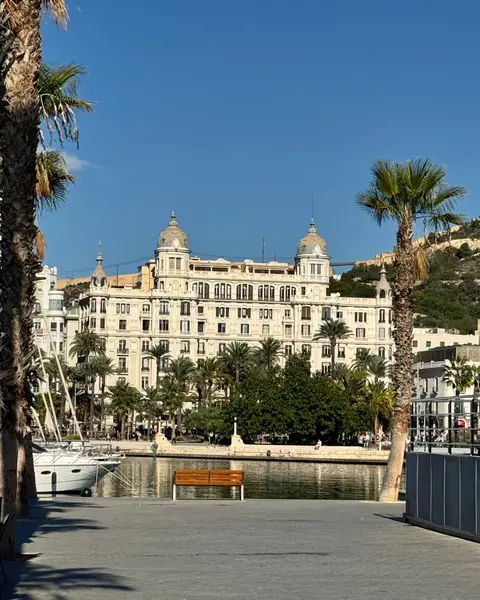
- The Explanada corner: the start of the palm promenade with its 6.6 million marble tiles in red, cream and black waves (1955), and Casa Carbonell at the Puerta del Mar end.
- Plaza del Ayuntamiento (38.3450, -0.4811): through the arch of Calle Mayor onto the pedestrian square of 2009, with the baroque town hall across it. Inside the door, at the foot of the staircase, the cota cero and the Dalí. 8 minutes from Portal de Elche.
- Plaza de la Santísima Faz: behind the town hall, the terrace square of the old town, named after the city's holy relic.
- Concatedral de San Nicolás (38.3456, -0.4823): the cultural visit enters through the cloister on Calle Labradores; the blue dome rises 45 metres above the nave.
- Calle Labradores and Plaza de San Cristóbal: the bar streets of El Barrio, quiet by day, full after 23:00.
- Calle Mayor: the old town's spine, shops and cafés, back towards the sea side.
- Plaza de Santa María (38.3462, -0.4792): the Basílica on the site of the great mosque, the MACA next to it in the city's oldest civil building (1685), the Museo de Aguas a minute further at Plaza del Puente.
- Plaza del Carmen: the foot of the stairs. From here the Barrio de Santa Cruz climbs to the Ermita, the Ereta park and the castle: another half hour up, or a lift ride from Postiguet.
Basílica de Santa María: the oldest church, and how to visit it
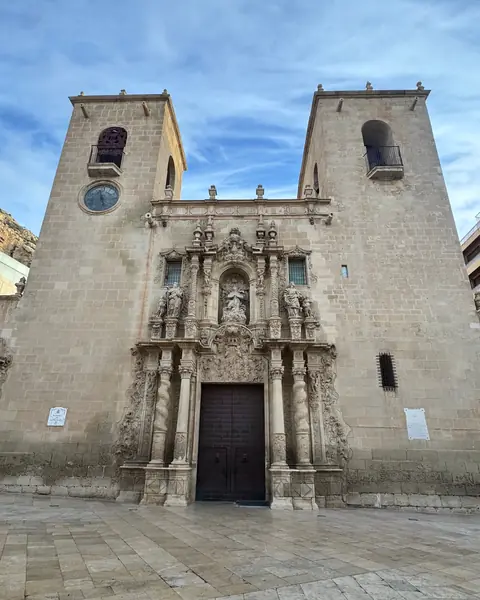
The Basílica de Santa María (in English, the Basilica of St Mary of Alicante) stands on the site of Alicante's great mosque, which Alfonso X had consecrated to Mary after the conquest of 1248.
The building is Valencian Gothic of the 14th to 16th centuries: a single nave with chapels between the buttresses, two unequal towers (one medieval, one of 1713), a baroque portal with sculptures by Juan Bautista Borja and, inside, a gilded rococo high altarpiece of the 18th century and a Carrara-marble font of the 16th (dates from the Spanish Wikipedia; the parish's own pages say only "14th century, on the great mosque"). It was declared a national monument in 1983 and a basilica in 2007, and it is the city's oldest church still in use.

The visit (parish visit service, checked 8 November 2026). The ticket covers the whole church, the chapter house and museum, the choir, the baptistery, the Inmaculada and Communion chapels and the bell tower. Address: Plaza de Santa María 1. Accessibility: a ramp at the entrance but a small step at the door, no adapted toilet (an accessible-tourism portal, 2018).
Cultural visit
- Monday to Saturday
- 10:00–19:00
- Sunday
- 13:00–19:00
Mass: the visit pauses
- Monday to Saturday
- 10:30 and 19:30
- Sunday
- 12:00 and 19:30
Last entry 30 minutes before closing. During mass the church is reserved for worship.
- Children 12 and under with an adult
- Free
- Adults
- EUR 6
- Over-65s
- EUR 5
- Ages 13–17, students to 25 and groups of 20 or more
- EUR 4
- School groups
- EUR 3
- Audio guide with a free ticket
- EUR 3
- Spanish, English, French, Italian; included in paid tickets
- Guided tour for groups of 20 or more
- EUR 10 a head
- Booked 48 hours ahead
Concatedral de San Nicolás: Alicante's cathedral, with a blue dome
People ask for "the cathedral of Alicante" and mean San Nicolás. It is a co-cathedral: since a papal bull of 9 March 1959 it shares the bishop's seat with the cathedral of Orihuela, which is why the diocese is called Orihuela-Alicante.
The church was designed between 1610 and 1615 by Agustín Bernardino, a pupil of Juan de Herrera, begun in 1616 on the remains of a mosque and an earlier Gothic church, and finished in 1662: a severe Renaissance building in the Herrera manner, with a stone dome of about 45 metres by Miguel del Real, a 15th-century cloister entered from Calle Labradores, a high-baroque Communion chapel of the 18th century and the oldest organ in the Valencian region (1591, restored and reinaugurated in 2021, per Wikipedia). San Nicolás is the city's patron; the Virgen del Remedio, the patroness, is venerated in the Camarín behind the sacristy.
The visit (tourism office and the cathedral's visit service, checked 8 November 2026). The route runs through the cloister, the chapter house and museum, the ante-sacristy, the Camarín, the upper galleries, the bell-ringer's room, the Communion chapel, the bell tower and the roof, with the old town at your feet. The church is open free for worship outside the visit; mass times are on the parish website. Address: Plaza del Abad Penalva 2.
Cultural visit 1 October to 30 April (every year)
- Monday to Friday
- 10:30–19:00
- Saturday
- 10:30–17:30
- Sunday
- 13:30–17:30
Cultural visit 1 May to 30 September (every year)
- Monday to Friday
- 10:30–19:30
- Saturday
- 10:30–18:30
- Sunday
- 13:30–19:00
Open free for worship outside the visit
- Winter, Monday to Friday
- 8:30–13:00 and 17:30–20:00
- Summer
- Afternoons from 18:00
Last entry 30 minutes before closing. The nave itself is part of the visit only between 13:00 and 17:00.
- Children 12 and under with an adult
- Free
- Adults
- EUR 8
- Over-65s
- EUR 7
- Ages 13–17; youth or university card holders up to 25
- EUR 6
- Groups of 20 or more
- EUR 6
- Disability of 33% or more
- EUR 6
- School groups
- EUR 4
Audio guide included in paid tickets; EUR 5 with a free ticket.
The town hall, the cota cero and La Ciudad Descubierta
The Ayuntamiento is a baroque palace with a 49-metre facade between two towers, begun in 1699 after the French bombardment had destroyed its predecessor and finished in 1780 (the architect: the tourism office names Lorenzo Chápuli, the council's heritage page "V. Soler").
Inside are the Salón Azul, the blue room where Queen Isabel II stayed in 1858, the council chamber and a chapel; they can be visited individually, without a group, in the town hall's visiting hours (town hall, 11 November 2026). The square in front, pedestrian since 2009 with orange trees and a flush fountain, is where the official Hogueras bonfire burns every 24 June and where the city sees in the New Year.
The cota cero. At the foot of the main staircase, just inside the door, a small marker labelled NP1 is the point from which every altitude in Spain is measured. Nineteenth-century engineers chose Alicante because the sea here has almost no tide; the level was fixed from tide-gauge readings in the port between 1870 and 1874 (Wikipedia). A sculpture by Salvador Dalí stands next to it. Ask at the door; it is free to see on weekday mornings.
La Ciudad Descubierta. Under the modern annex at Calle Jorge Juan 3, an archaeological space shows what was found when the annex was built: Islamic houses of the 12th and early 13th centuries, the late-13th-century wall of the Vila Nova with its outer wall and towers, 16th-century shops along a planned street and houses of later centuries. Entry is free; the hours are the tourism office's, and the council's page, last updated in 2015, still gives 9:00–14:00 all year.
- Monday to Friday
- 9:00–14:00
- July to September 9:00–13:00
- Saturday, Sunday
- Closed
- Also closed on holidays
The squares, the streets and the edges
- Plaza del Ayuntamiento: the civic square (above), reached from Calle Mayor through the Pórtico Consistorial.
- Plaza de la Santísima Faz: behind the town hall, cafés and terraces under the towers; the quiet way into El Barrio.
- Plaza de San Cristóbal (38.3469, -0.4838): the western square of El Barrio by the Rambla, bars on every side.
- Calle Labradores and Calle Mayor: the two main streets, Labradores for the bars and the cathedral cloister, Mayor for the shops.
- Plaza de Santa María and Plaza del Puente: the Basílica, the MACA and the Museo de Aguas at the foot of the Ereta park.
- Plaza del Carmen: the foot of the Santa Cruz stairs, with the first white houses.
The Rambla and Portal de Elche
The Rambla de Méndez Núñez was built in 1858 where the wall had stood, and it still separates the old town from the 19th-century centre: the old town's bus stop, taxi rank and shop fronts are here.
At its sea end, the Portal de Elche square keeps the memory of the city gate on the road to Elche: a garden of 19th-century kiosks (one replica survives) under four Ficus macrophylla 13 to 19 metres high, three of them protected trees, on the spot that was the Plaza de las Horcas, the gallows square, until 1810.
A block towards the sea, Plaza Gabriel Miró, the former Plaza de Correos, has the Aguadora fountain (1918, for the arrival of drinking water) and the largest ficus in the country. The Explanada, the palm promenade on the old sea wall, dates from 1868; its wave mosaic of 6,600,000 marble tiles from 1955.

El Barrio by night, and the tardeo
El Barrio is Alicante's traditional going-out quarter: small bars, pubs and a few clubs in the lanes between Plaza de San Cristóbal, Calle Labradores, Calle San Pascual, Calle Santo Tomás and Plaza de la Santísima Faz, with a second, newer circuit across the Rambla on Calle Castaños. The evening starts late, around 23:00, and Thursday to Saturday are the nights.
The tardeo is the Saturday-afternoon version, drinks and tapas from lunchtime into the evening, born in the Castaños area and spread to El Barrio.
New rules. After years of complaints from residents, the council declared the core of El Barrio an acoustically saturated zone (Plaza Quijano, Calle Virgen de Belén, Calle Padre Maltés, Calle San Agustín and Calle Montengón), approved in autumn 2025 and in force since its publication on 19 November 2025:
Sunday to Thursday
- Bars, cafés and pubs close
- 00:30
- Discos close
- 01:00
Fridays, Saturdays and the eves of holidays
- Bars, cafés and pubs close
- 01:00
- Discos close
- 03:00
Terraces
- Can stay out
- 08:00–00:00
- To 00:30 on summer weekends
Terraces were cut by half; no new licences or terraces; no serving through windows to the street. Separate hours apply during Hogueras, Christmas and New Year. Some 2,700 people live in the quarter: keep the lanes quiet after the bars close.
Where to eat in the old town
The old town is where Alicante eats out: tapas bars on Labradores and around San Cristóbal, rice restaurants and a few rooftops. Named places below were checked on 8 November 2026 against their own pages and will be kept dated; hours change by season.
- Nou Manolín, Calle Restaurador Vicente Castelló 3 (the former Calle Villegas): the city's classic tapas bar, open since 1971 by its own account, with a bar and dining rooms, just across the Rambla.
- La Taberna del Gourmet, Calle San Fernando 10: tapas, fish and rice, 13:00 to 23:30 (to 00:00 Friday and Saturday); book online.
- El Portal, Calle Bilbao 2: a smart gastro-bar with a long menu and cocktails, open 13:00 to 01:00 (to 02:00 Friday and Saturday).
- Steki, Calle Argensola 8: Mediterranean with Greek and Mexican touches, dinner only (19:00 to 22:00), closed Tuesday and Wednesday.
- La Milagrosa Rooftop, Calle Villavieja 8: the roof terrace of Hotel La Milagrosa, with the castle above the roofs; ask whether it is open to non-guests.
- Swallow Specialty Coffee, Plaza del Carmen 13: coffee at the foot of the Santa Cruz stairs.
- The Mercado Central, ten minutes up Calle Alfonso X el Sabio: the market bars for a mid-morning snack and the Saturday vermouth; hours in things to do in Alicante.
Museums and free things inside the old town
Three free museums sit inside the triangle: the MACA (contemporary art, Plaza de Santa María), the MUBAG (fine arts, Calle Gravina) and the Museo de Aguas in the rock cisterns at Plaza del Puente; the Civil War air-raid shelters under Plaza Séneca are a guided visit a few minutes west. Hours, free days and closures are on the museums guide.
Also free among the things to do in Alicante Old Town: the churches at worship times, the cota cero and La Ciudad Descubierta, the squares, the Explanada and the climb through Santa Cruz. For children, or an hour of rain, the Museum of Illusions is a short walk away in the shopping streets.
Also free: LAB15, in the Palau el Portalet at Calle Labradores 15, an 18th- to 19th-century palace that belongs to the city council. Entry is free until the rooms are full. Its hours, from the notice at the door:
LAB15
- Monday
- Closed
- Tuesday to Friday
- 10:30–14:00 and 18:00–21:00
- Saturday, Sunday
- 10:30–14:00
- Public holidays
- 10:30–14:00
The old town's calendar
- Holy Week (March or April): processions through the old town; the best known leaves the Ermita de Santa Cruz on Holy Wednesday at 19:00 and comes down the stairs to San Nicolás (see the Santa Cruz guide).
- Cruces de Mayo (around the first weekend of May): flower crosses on the Santa Cruz stairs, with a procession down to San Nicolás on the Sunday.
- Hogueras de San Juan (20–24 June): the official bonfire is planted and burned on Plaza del Ayuntamiento; the Cremà starts at midnight on 24 June with the Palmera firework from the castle, the official bonfire first, then the district ones. Bar hours are extended by decree.
- Christmas and New Year: the Christmas lights from late November and the giant Nativity scene on Plaza del Ayuntamiento until 7 January; New Year's Eve chimes from the town hall clock (in 2025-26 the street party was on the Rambla and at Portal de Elche); the medieval market, Alicante Medieval, is held in May, not December.
Accessibility and practicalities
- Flat below, stairs above: the whole old town between the Rambla and Plaza del Carmen is flat, cobbled in places and pedestrian; the stairs begin at Plaza del Carmen. Prams and wheelchairs manage the flat part; the Basílica has a ramp but a step at the door (2018 report).
- Toilets: public toilets: none in the lanes; the Mercado Central has them, otherwise the bars.
- At night: busy and lit until the bars close; the quiet lanes after 01:00 are quiet, not dangerous. Watch bags in the crowds of Hogueras and summer evenings.
- Sundays and Mondays: the market is closed on Sunday, most museums on Monday; the churches' visits run every day except during mass.
Frequently asked questions
What is the old town of Alicante called?
The Casco Antiguo, or El Barrio. The whitewashed upper part is the Barrio de Santa Cruz. The 19th-century shopping grid west of the Rambla is the Centro tradicional, not the old town.
Where is the old town in Alicante?
Between the Rambla de Méndez Núñez, the Explanada and the castle hill, five minutes from the port and the Postiguet beach. TRAM stops Mercado and Luceros are at its edge.
Is the old town the same as the Barrio de Santa Cruz?
No. Santa Cruz is the stair quarter on the slope above Plaza del Carmen; the old town is the flat quarter below it with the town hall, the churches and the bars. Guides and Google often use the names for one another.
Is Alicante walkable?
Yes. The old town, the Explanada, the port, the market and the Postiguet beach are all within fifteen minutes of each other on foot; only the castle is a climb, and it has a lift.
How long do I need?
An hour for the walk; half a day with the Basílica, the Concatedral and the town hall; an evening if you stay for tapas.
Is the Basílica de Santa María free?
Entry for the cultural visit costs EUR 6 (EUR 5 over 65, EUR 4 for ages 13–17, students up to 25 and groups of 20 or more, free for children 12 and under with an adult), audio guide included in paid tickets (EUR 3 with a free ticket), Monday to Saturday 10:00–19:00 and Sunday 13:00–19:00. During mass the church is open for worship only.
Does Alicante have a cathedral, and what does it cost?
San Nicolás is a co-cathedral, sharing the bishop's seat with Orihuela since 1959. The cultural visit costs EUR 8 (EUR 7 over 65, EUR 6 for ages 13–17 and youth or university card holders up to 25, free for children 12 and under with an adult), audio guide included in paid tickets (EUR 5 with a free ticket); the church is free at worship times.
What is the cota cero?
The marker NP1 at the foot of the town hall staircase from which all altitudes in Spain are measured, chosen in the 19th century because Alicante's sea has almost no tide. A Dalí sculpture stands beside it.
Where is the mushroom street?
Calle San Francisco, two minutes west of the old town across the Rambla, from Portal de Elche to Plaza de Calvo Sotelo. It has its own guide.
What is the tardeo?
Saturday-afternoon drinking and tapas, from lunchtime into the evening, in the bars of El Barrio and Calle Castaños: Alicante's answer to the late night.
Is the old town safe at night?
Yes: busy and well lit until the bars close at 00:30 or 01:00. Use the usual care with bags in crowds, and keep your voice down in the lanes where people live.
Sources
- Alicante tourism office (Alicante City & Beach): Town Hall / cota cero / La Ciudad Descubierta page (opens in a new tab) (hours), Basílica (opens in a new tab) and Concatedral (opens in a new tab) pages (visit hours and prices, bus and TRAM lines), the "Centro tradicional" tree trail (opens in a new tab) and the gardens pages (Explanada (opens in a new tab), Portal de Elche (opens in a new tab), Plaza Gabriel Miró (opens in a new tab), Plaza del Ayuntamiento (opens in a new tab)); checked 8 November 2026.
- Basílica de Santa María visit service (basilicaalicante.com, PROCURATIO) (opens in a new tab): cultural visit hours, prices, audio guide, guided tours, mass times (opens in a new tab); checked 8 November 2026.
- Concatedral de San Nicolás: parish website (opens in a new tab) (worship hours by season (opens in a new tab), history), visit service (sannicolasalicante.com) (opens in a new tab) and the Diocese of Orihuela-Alicante (opens in a new tab) (construction dates, the 1959 bull); checked 8 November 2026.
- Alicante city council (alicante.es): heritage page of the town hall (opens in a new tab) (1699–1780, facade, Salón Azul, monument 1961), La Ciudad Descubierta page (opens in a new tab) (free, hours), the acoustically saturated zone of the Casco Antiguo (opens in a new tab) (approval 2025, DOGV 19 November 2025, closing times), the Hogueras page (opens in a new tab) (20–24 June, the official bonfire); checked 8 November 2026.
- TRAM d'Alacant (tramalacant.es) (opens in a new tab): lines per stop; checked 8 November 2026.
- Secondary: Spanish Wikipedia on the Basílica (opens in a new tab) (dates, 1983, 2007), the Concatedral (opens in a new tab) (dome height, organ), the town hall (opens in a new tab) (cota cero measurements 1870–74) and El Barrio (opens in a new tab); OpenStreetMap for coordinates; checked 8 November 2026.